Vocal nodules in children and adults: what actually helps, and how to protect your voice
Vocal nodules are firm thickenings that form when the voice works too hard for too long. They mostly affect two groups that seem to have little in common: school-age children, often active and talkative boys, and adults who talk all day, such as teachers and daycare educators.
Parents often describe the same scene to us. After a hockey weekend or a week of day camp, their child sounds rough and raspy, and the voice never quite comes back. In adults, Friday usually tells the story: a voice that’s fine on Monday is worn out by the end of the week.
This guide explains what vocal nodules are, why they form, what differs between children and adults, and what research says about the most common advice. It also walks through the actual route to care in Québec, from your family doctor to the ENT and the speech-language pathologist, and what voice therapy involves. You’ll know when to consult, what really helps, and what to start this week.
What are vocal nodules?
A vocal nodule is a benign thickening, a bit like a callus. Nodules form on both vocal folds, at the point where they strike each other hardest. They stop the folds from closing completely, so air leaks through and the voice sounds hoarse, breathy or tired.
To understand why, it helps to know how voice is made. Inside the larynx, behind the Adam’s apple, two folds of muscle and lining come together when we speak. Air from the lungs makes them vibrate. According to the Québec teachers’ union guide on voice disorders (in French), the vocal folds touch between 100 and 300 times per second when we talk.
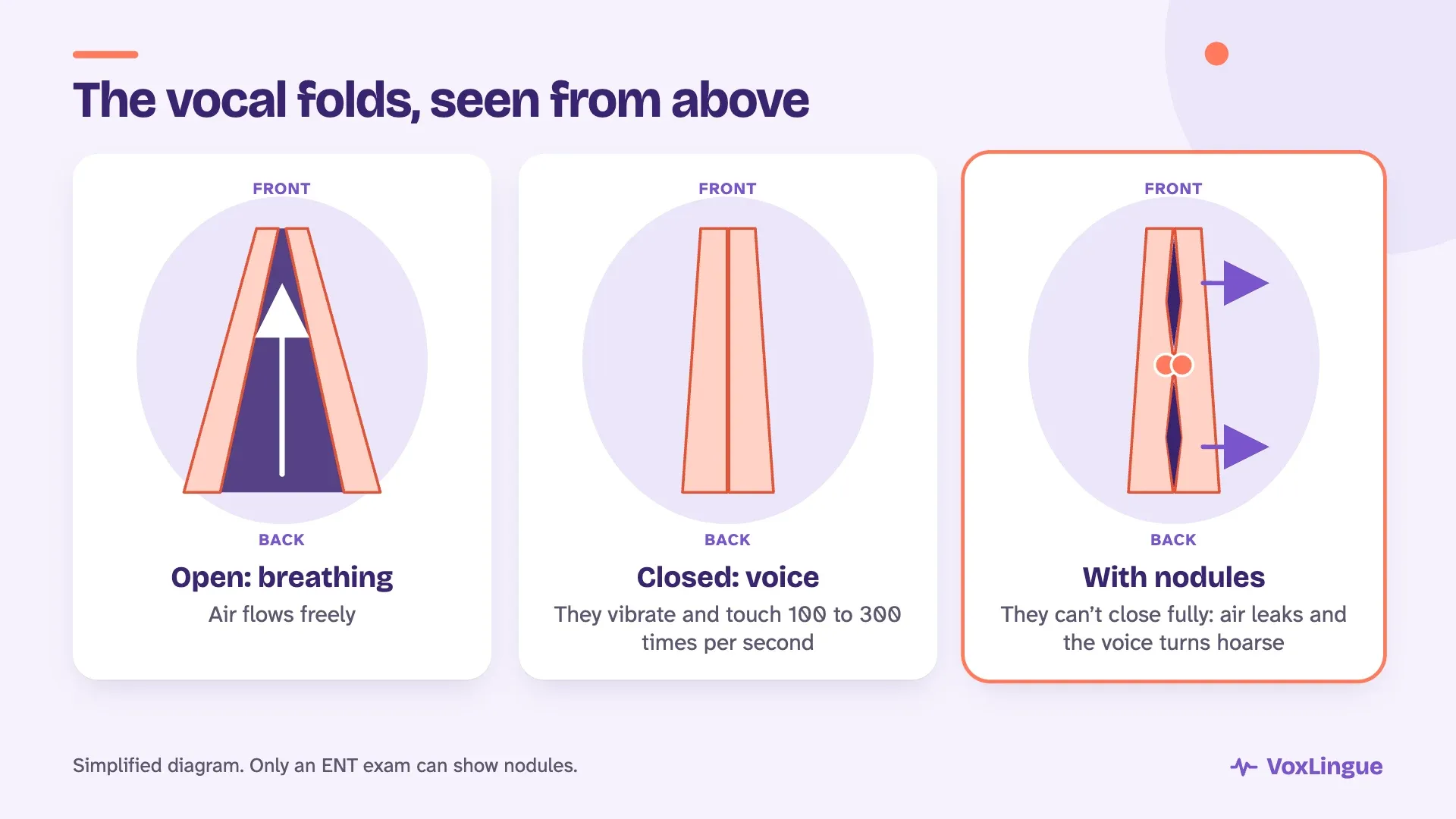
When that contact is too forceful and too frequent, the lining reacts like the skin of a hand that keeps hitting the same spot. It thickens. Nodules form in the middle of the vibrating part of the folds, facing each other, on both sides at once. Specialists call this phonotrauma: repeated injury from using the voice.
A nodule is not cancer. It’s a benign lesion, and the problem is mechanical. With two bumps in the middle, the vocal folds can’t close all the way. A gap remains in front and behind, a bit like an hourglass, and air escapes through it. The result is a breathy, husky or rough voice.
To make up for it, people push harder. They tighten the throat and talk louder to be heard, so the folds hit each other even harder. That’s the cycle voice therapy sets out to break.
Nodules, polyps and cysts: what’s the difference?
All three are benign lesions of the vocal folds, but they behave differently. Nodules appear on both sides and respond well to voice therapy. A polyp is often on one side only and can follow a single episode of shouting. A cyst sits under the surface and rarely goes away with therapy alone.
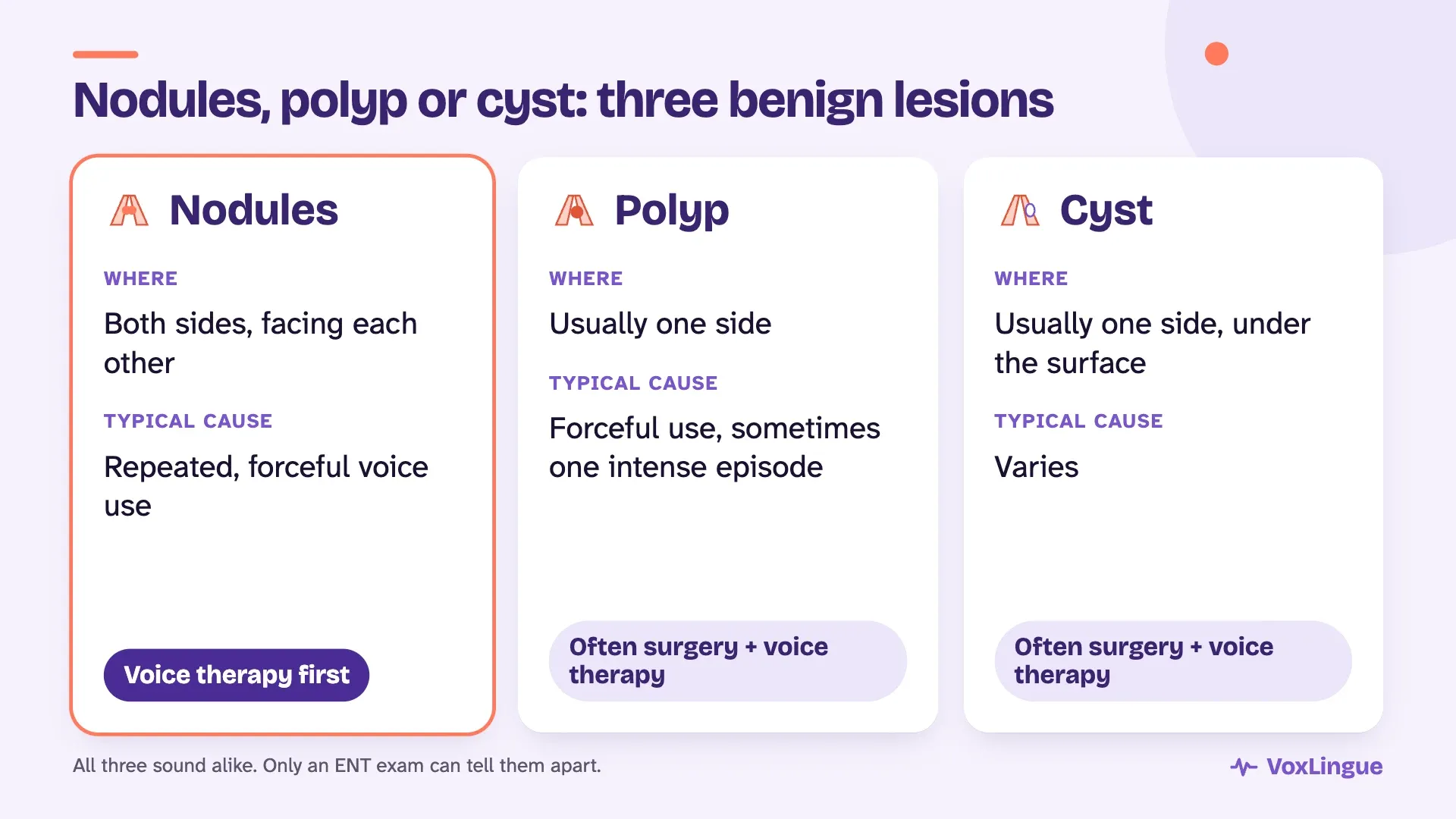
| Nodules | Polyp | Cyst | |
|---|---|---|---|
| Where | Both sides, facing each other | Usually one side | Usually one side, under the surface |
| Typical cause | Repeated, forceful voice use | Forceful use, sometimes a single intense episode | Varies |
| First treatment | Voice therapy | Often surgery, with voice therapy | Often surgery, with voice therapy |
These lesions sound very similar. Only an exam of the vocal folds by an ear, nose and throat specialist (ENT, also called an otolaryngologist) can tell them apart. That’s why nobody can diagnose nodules “by ear”: they have to be seen.
Why do vocal nodules form?
Nodules form when vocal load exceeds the vocal folds’ ability to recover. Talking or yelling loudly, for long periods, often over background noise, is the main cause. Other factors make the voice more fragile: poor breath support, reflux, allergies, dry air, too little sleep and stress.
A simple way to picture it is vocal load. It depends on three things: volume, duration and background noise. Talking loudly for an hour in a quiet room is less tiring than talking loudly all day in a gym or a daycare. Noise pushes everyone to raise their voice without noticing.
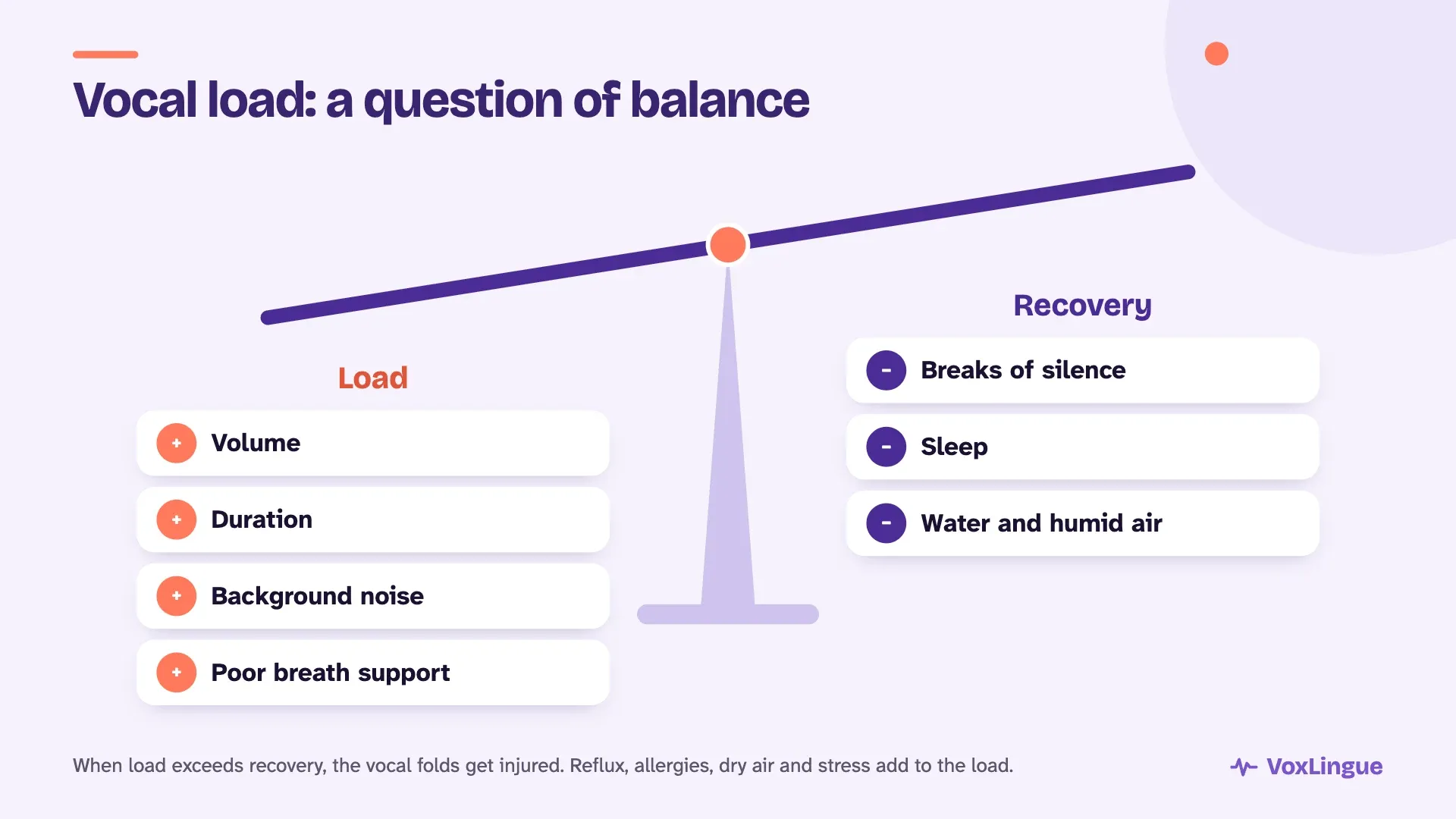
On the other side of the scale is recovery: breaks, sleep and moments of silence. According to the American Academy of Otolaryngology clinical practice guideline (2018), voice problems affect nearly one in three people at some point in life. Most of the time, the issue is the balance between what you ask of your voice and the rest you give it.
Breathing plays a role people often overlook. A strong voice starts with good breath support: without breath, there’s no power. In both children and adults, we often see people who don’t support their voice with their breath and don’t know when to stop and take a breath. They finish sentences out of air and end up pushing with the throat.
Other factors add to the load. Reflux and allergies irritate the larynx. Dry air and mouth breathing dry out the surface of the vocal folds. Smoking damages them. According to the Québec teachers’ union guide, work stress and nights of less than six hours of sleep are each linked to about twice the risk of a voice disorder.
Signs of a strained voice
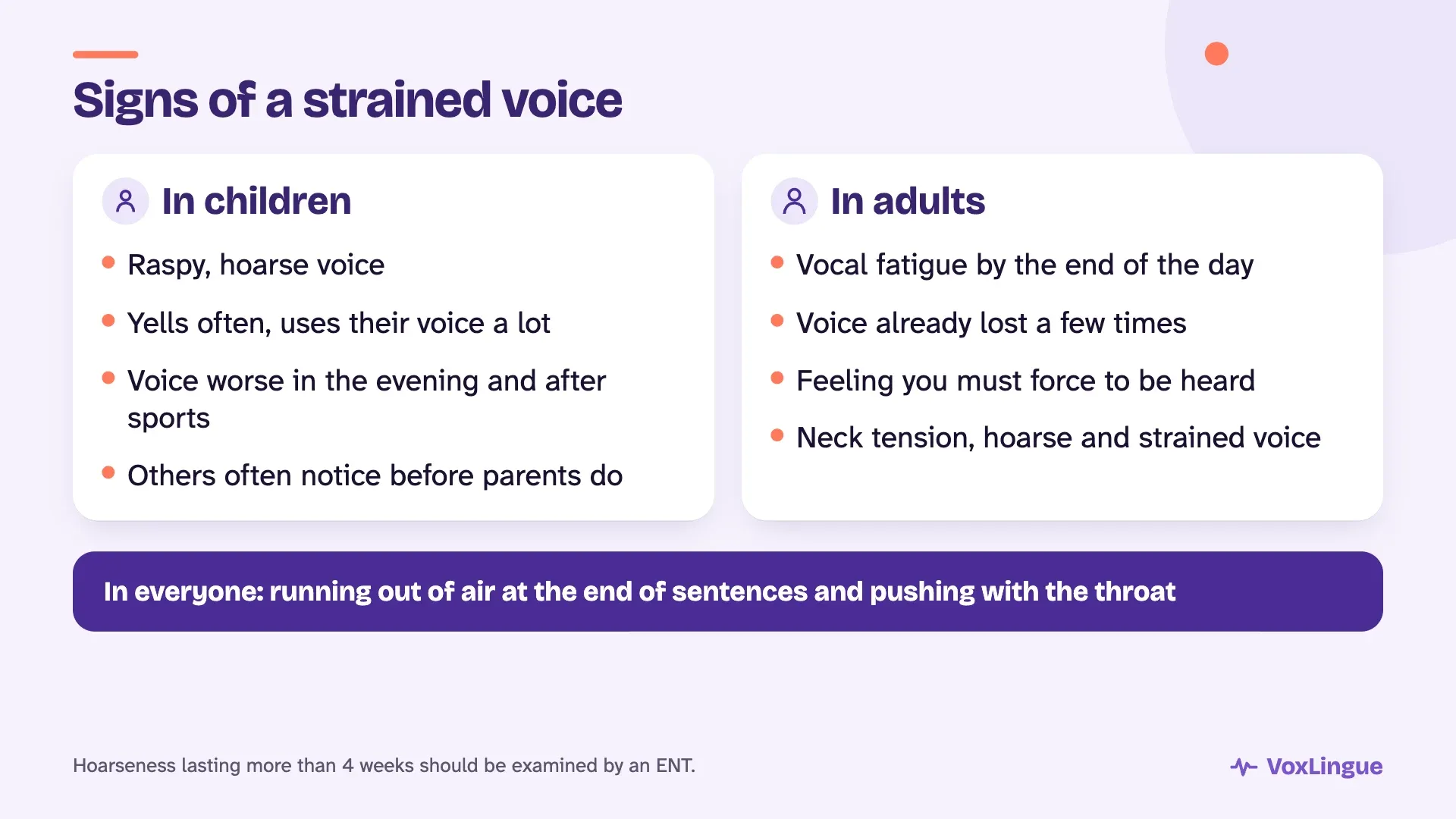
Several signs point to a voice that’s working too hard. The most common are a hoarse, rough or breathy voice that doesn’t come back, a voice that gives out by the end of the day, and a feeling of having to push to be heard. With children, other adults often notice before parents do, because we get used to our own child’s voice.
Watch for these signs, in children and in adults:
- a hoarse, raspy, husky or breathy voice that lasts more than a few weeks;
- a voice that tires or fades by the end of the day, or after sports;
- feeling you have to push to be heard, or running out of air at the end of sentences;
- tension or discomfort in the neck and throat when talking;
- a voice that cracks, high or soft notes that won’t come out, or frequent throat clearing.
Children’s voice problems often go unnoticed. A large US survey found that only 1.4% of children were reported by their parents as having a voice problem, and fewer than a quarter of those received any voice services (Bhattacharyya, 2015). Yet when clinicians listen to 8-year-olds, they rate about 6% as dysphonic (Carding et al., 2006).
If a teacher, a coach or a grandparent tells you your child often sounds hoarse, take it seriously.
Vocal nodules in children: who, why, and what happens at puberty
Nodules are the most common cause of long-lasting hoarseness in children. They affect more boys, children with siblings, and kids who yell a lot at play or in sports. Many boys improve at puberty, but girls less often, so girls deserve follow-up.
Studies of children point the same way. In a screening of 617 students aged 7 to 16, nodules were seen in 21.6% of boys and 11.7% of girls (Kılıç et al., 2004).
Most of those children had no symptoms, though. Screening finds lesions nobody had noticed, so this doesn’t mean one child in five needs treatment. In a large British cohort, being a boy and having older siblings increased the risk (Carding et al., 2006).
Why school-age boys? Their play is often louder, team sports are played shouting, and in a family with several kids, you sometimes have to raise your voice to get a turn. Imitating monsters, cartoon characters or sports announcers also strains the larynx. One research review also lists attention deficit hyperactivity disorder (ADHD) among the risk factors (Mudd and Noelke, 2018).
What we often see
In children with nodules, we usually hear a raspy, hoarse voice. They’re often children who scream a lot or use their voice excessively: at play, in sports, at recess or at home. Parents often notice the voice is worse in the evening and after busy weekends.
Does puberty change things?
Yes, but not the same way for girls and boys. A Belgian study followed 91 children who had nodules (De Bodt et al., 2007). After puberty, voice complaints persisted in 8% of boys and 37% of girls. Among the teens re-examined, nodules were still visible in 7% of boys and 47% of girls.
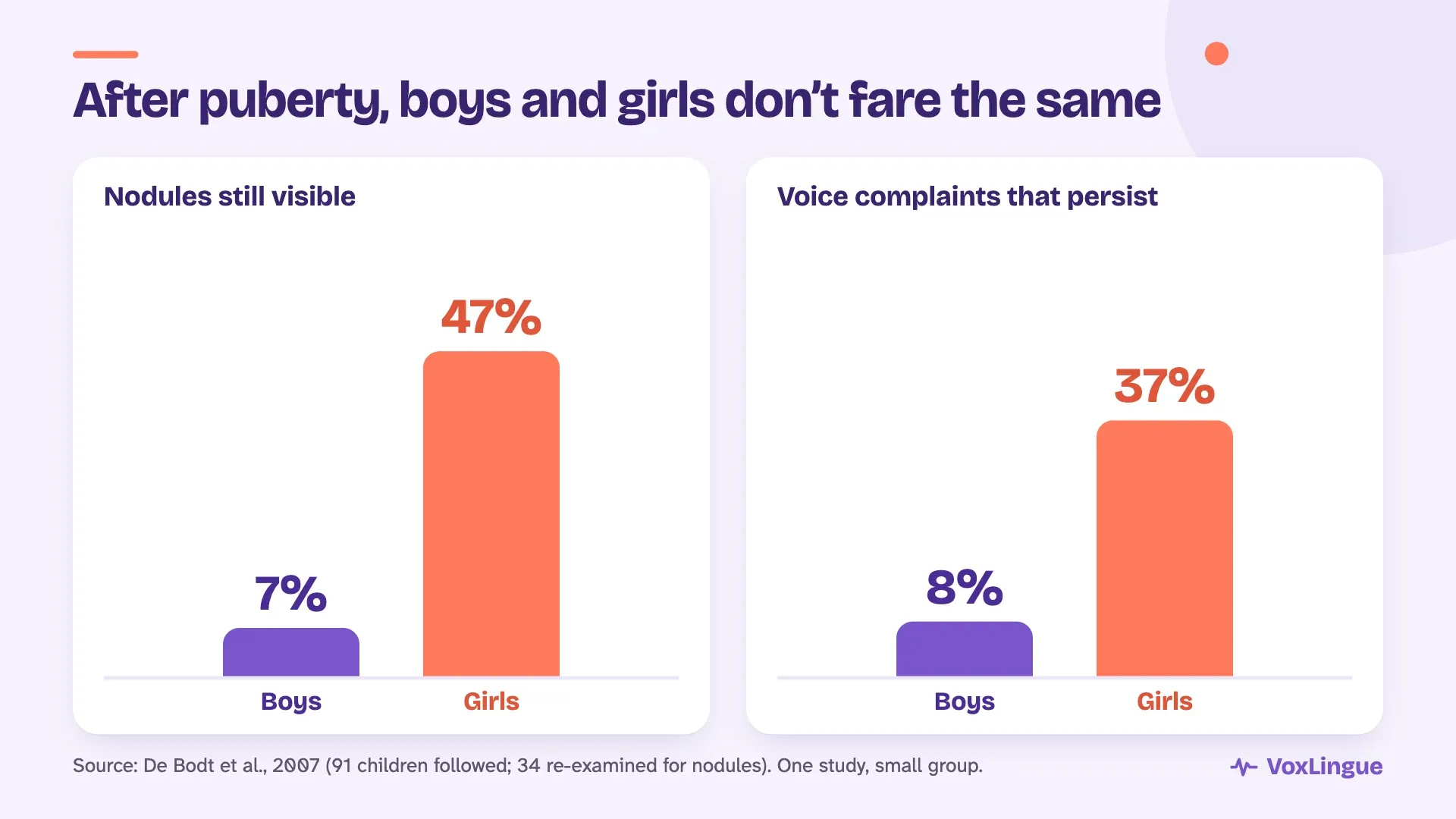
It’s one study, with a small group re-examined, but it matches what clinicians see. In boys, the voice change at puberty transforms the larynx and often makes nodules disappear. In girls, that change is less dramatic. Don’t count on puberty to fix everything, especially for a girl, and don’t wait years with a voice that’s straining.
Does my child need to stop talking?
No. Complete silence isn’t realistic or necessary for a child, and there’s no evidence that it cures nodules. What helps is changing how the voice is used: yelling less, talking over noise less, breathing better while speaking, finding other ways to get attention, and taking breaks.
Telling a child to be quiet also sends the message that their voice is the problem. We prefer the opposite: teaching them to find their good voice, the one that carries without strain. Children get this idea quickly when it’s presented as a game, and parents soon become their best allies.
Vocal nodules in adults: teachers, educators, singers and other voice professionals
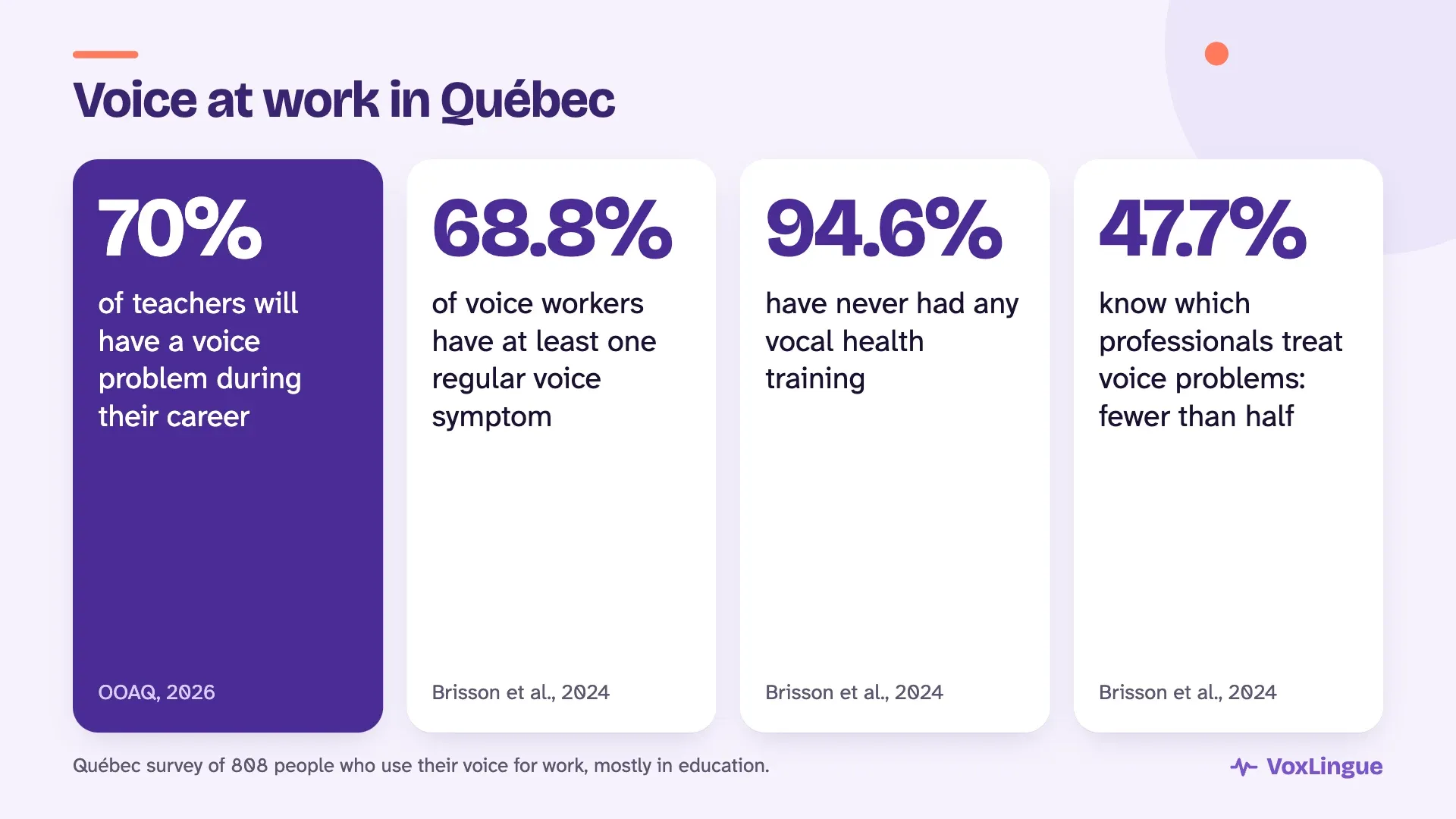
In adults, nodules mostly affect women and people who talk a lot, often over noise: teachers, daycare educators, coaches, singers, and call-centre staff. According to Québec’s professional order of speech-language pathologists and audiologists (OOAQ), 70% of teachers will have a voice problem during their career.
The OOAQ’s page on voice disorders (in French) adds that women have about twice the risk of men. A large US study compared 1,243 teachers with 1,288 other adults (Roy et al., 2004). Over their lifetime, 57.7% of teachers had experienced a voice problem, compared with 28.8% of other workers.
Québec data are similar. In a survey of 808 people who use their voice for work, mostly in education, 68.8% had at least one regular voice symptom (Brisson et al., 2024). And 94.6% had never had any vocal health training. More striking still, only 47.7% knew which professionals treat voice problems.
Teachers aren’t the only ones at risk. The Québec teachers’ union guide also names daycare educators, school supervisors and special-education technicians. Singers, actors, coaches, fitness instructors, presenters and call-centre agents do the same job under another name: they make their living with their voice.
What we often see
In adults, we often see vocal fatigue and a voice that has already been lost a few times. People tell us they feel they have to force their voice to be heard, and they feel a lot of tension in the neck. Their voice is often very hoarse and strained, especially by the end of the work week.
When to see a doctor, and who to see
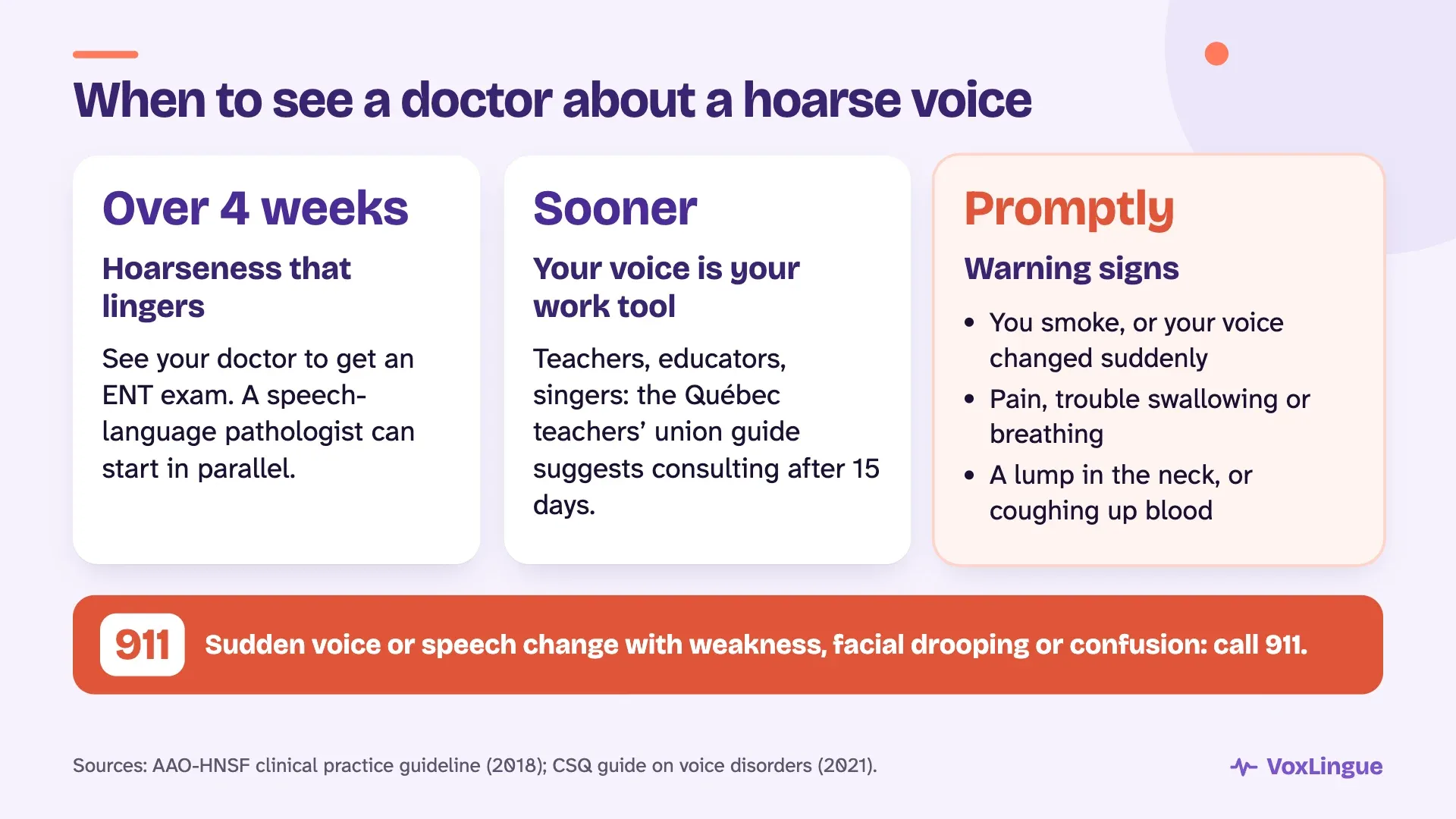
See your doctor if your voice stays hoarse for more than four weeks. Go sooner if you use your voice for work or if any warning sign appears. Only an ENT can confirm nodules by looking at the vocal folds. A speech-language pathologist can start helping you in parallel, without waiting for that diagnosis.
Four weeks is the most widely used threshold. The US clinical practice guideline on hoarseness recommends an exam of the larynx when the voice hasn’t improved in four weeks, or sooner if a serious cause is suspected. For teachers, the Québec teachers’ union guide even suggests consulting after 15 days. If your voice is your working tool, don’t wait a month.
Some signs mean you should see a doctor promptly, whatever the duration:
- you smoke, or your voice changed suddenly;
- you have pain, or trouble swallowing or breathing;
- you feel a lump in your neck, or you cough up blood.
A sudden change in voice or speech together with weakness, facial drooping or confusion is an emergency: call 911.
Who does what? The ENT is the physician who examines the vocal folds with a tiny camera, passed through the nose or mouth, and makes the diagnosis. The speech-language pathologist assesses how you use your voice, your breathing and your habits, then treats the problem. The two work together.
In Québec, you can see a speech-language pathologist without a medical diagnosis, as the OOAQ notes. For nodules, though, an exam of the larynx is essential: it’s what distinguishes a nodule from a polyp, a cyst or another lesion that would need different treatment.
Getting care in Québec: family doctor, ENT, speech-language pathologist
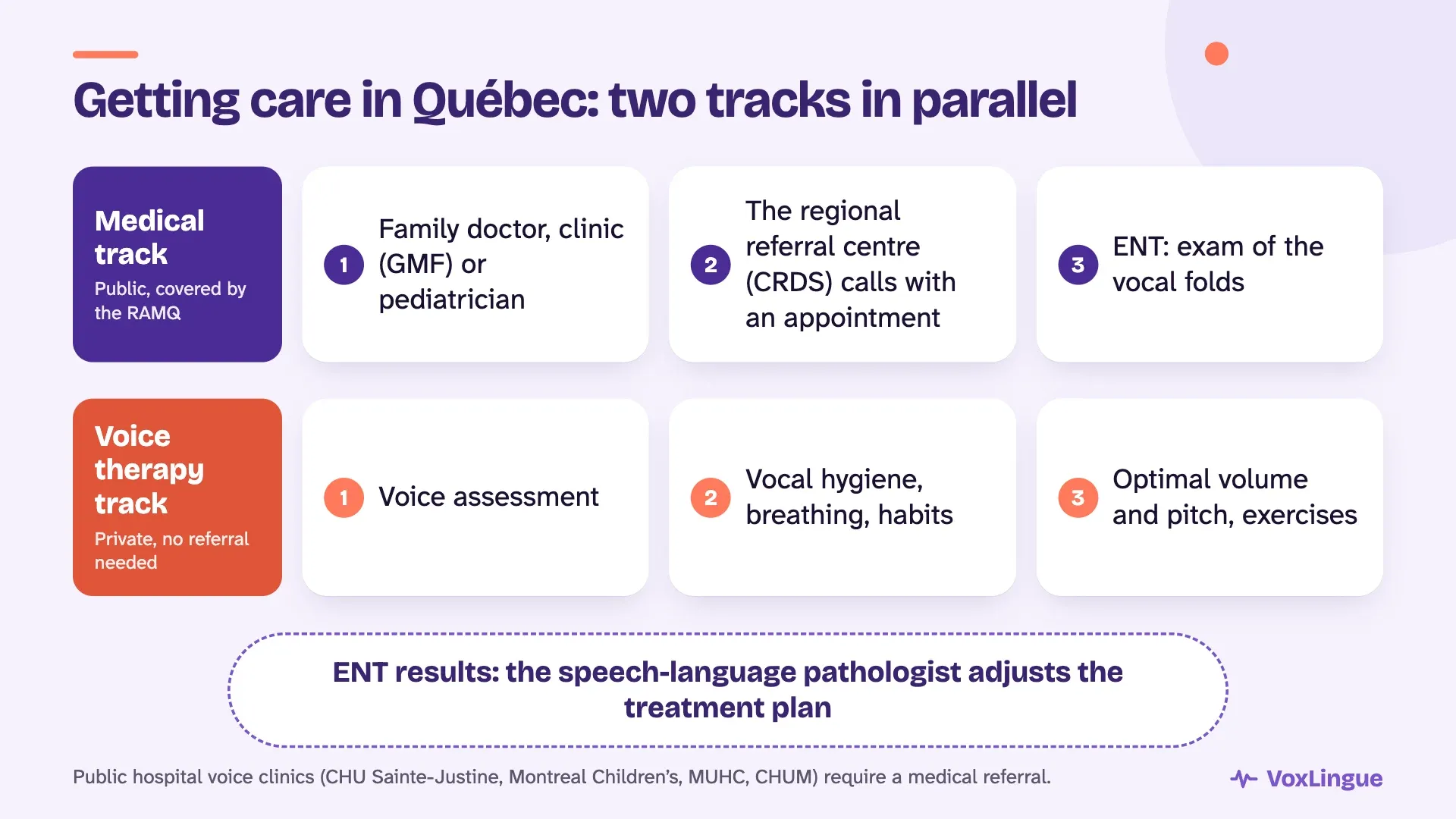
In the public system, your doctor requests the ENT consultation. Your region’s referral centre (CRDS) then calls you with an appointment, covered by Québec health insurance (RAMQ). In parallel, you can see a private speech-language pathologist without a referral and start working on your voice while you wait.
The medical track: from your doctor to the ENT
Everything starts with your family doctor, your clinic (GMF) or your child’s pediatrician. The doctor sends the ENT request to the regional referral centre: in Montréal, the CRDS montréalais calls you to set the appointment. The exam of the vocal folds is covered by the RAMQ.
Wait times depend on the region and on the priority assigned to the request. No official data give a reliable wait for voice problems, but the wait is often long.
For more complex cases, Montréal has specialized clinics where ENTs and speech-language pathologists work together, on medical referral. For children, there’s the Voice Clinic at CHU Sainte-Justine and the multidisciplinary voice clinic at the Montreal Children’s Hospital. For adults, there are the MUHC and CHUM teams.
The voice therapy track: start without waiting
Meanwhile, nothing stops you from starting work on your voice. You don’t need a referral to see a private speech-language pathologist, and our article on speech therapy assessments in Québec explains what a first appointment looks like. Private speech therapy isn’t covered by the RAMQ, but many group insurance plans reimburse part of it with a receipt from an OOAQ member. The OOAQ directory lets you search for private clinicians by area of practice, including voice.
How it works at VoxLingue
Most people who come to us for vocal nodules arrive with a referral from an ENT. If not, we always recommend an ENT consultation. Since the family doctor is the one who requests it, we give you a consultation note with our clinical observations to bring to your doctor.
We don’t wait for that appointment to begin. From our voice assessment onward, we work on vocal hygiene, on habits that may contribute to the problem, and on techniques to improve voice quality. Once the ENT has examined the vocal folds, we collaborate with them and adjust the treatment plan based on their findings.
Our speech-language pathologists see children and adults at our Montréal clinic and online, through telepractice anywhere in Québec and in Ontario. Online voice therapy works for children too. A Boston Children’s Hospital study saw clear improvement in children with nodules treated online, in a small group without a comparison group (Hseu et al., 2024).
How are vocal nodules treated? Voice therapy first
Voice therapy is the first recommended treatment for nodules. The goal is a voice that works well and without strain, even if the nodule doesn’t disappear completely. Surgery is kept for cases that don’t improve, and it must be followed by therapy so the nodules don’t come back.
The clinical practice guideline on hoarseness makes voice therapy a strong recommendation, after an exam of the larynx. In Québec, Laryngo.ca, the information site of an ENT laryngologist, describes voice therapy and vocal hygiene as the treatments of choice, effective in more than 90% of patients.
One thing often surprises families: success isn’t measured by the bump disappearing.
A trial followed 114 children aged 6 to 10 through 8 to 12 weeks of therapy. Their voice-related quality of life improved meaningfully in 53% to 61% of them (Hartnick et al., 2018). Yet when re-examined, the nodule had fully disappeared in only 11%. A voice can work well with a smaller nodule.
Breathing: the foundation of a strong voice
A big part of voice therapy is working on breathing. Kimberly Martins, speech-language pathologist and founder of VoxLingue, puts it simply: “A strong voice starts with proper breath support, and without respiration there is no power.” A voice that carries draws on breath used well.
We start with relaxed breathing, low in the ribs and belly, without lifting the shoulders. Then we work on coordinating breath and voice: starting to speak with enough air, and above all stopping to take a breath at natural pauses instead of pushing to the end of the sentence. That one change takes a lot of tension away.
What voice therapy looks like, session by session
It starts with an assessment. We listen to the voice, record it, and observe breathing, posture and tension. We also go through daily habits: how many hours of talking a day, in how much noise, with which sports, which songs, how much coffee and how much water.
Then come several parts, combined to suit the person:
- vocal hygiene adapted to your daily life: hydration, humidity, breaks, less noise;
- habits to change: yelling, forcing, throat clearing, but also whispering or talking too softly;
- breathing and breath support for the voice;
- finding your optimal volume and pitch, the ones that ask the least effort of your vocal folds;
- voice exercises, for example with a straw or sounds that make the lips and face vibrate, then carrying them into real life.
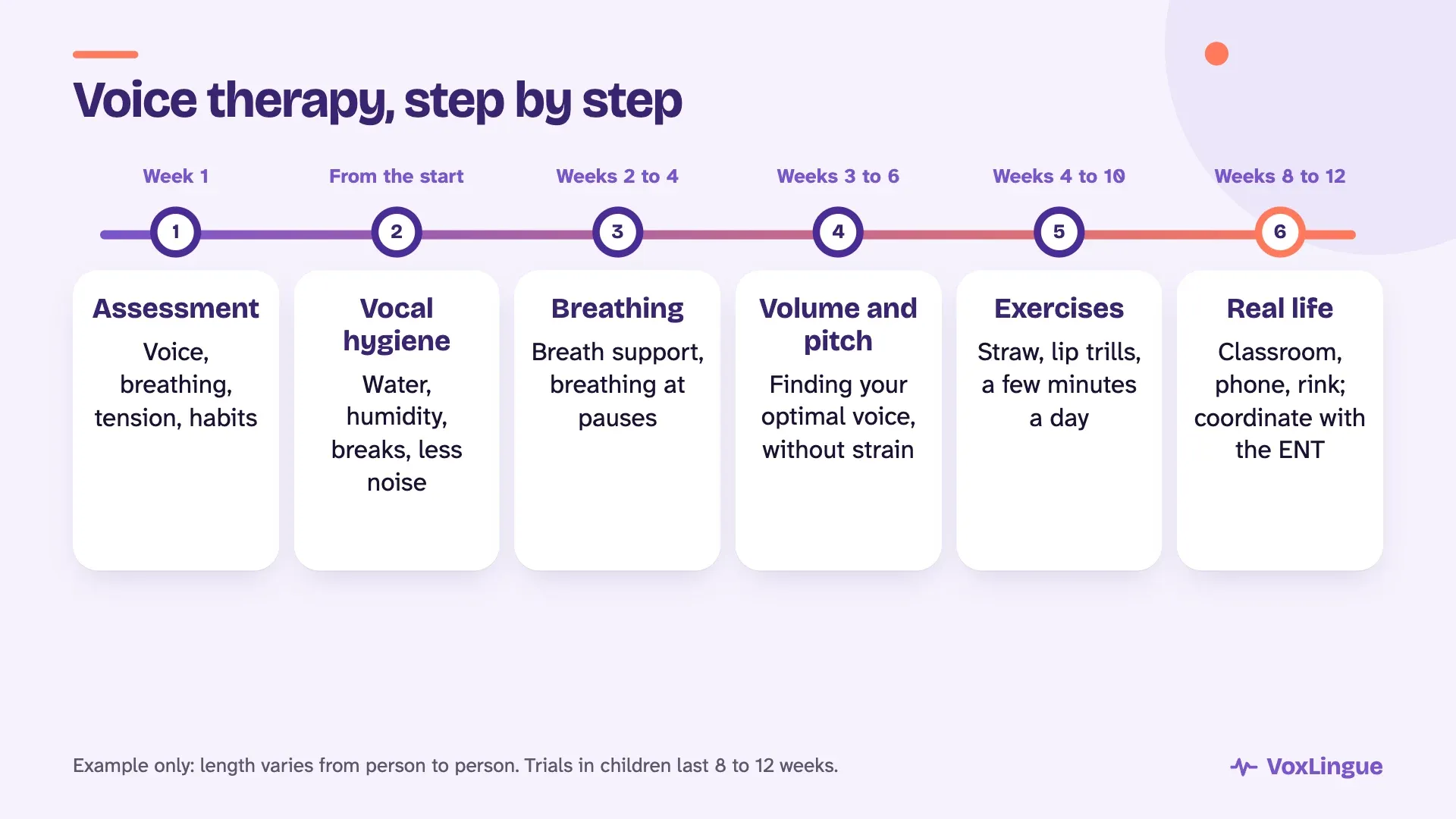
Sessions are short and practical. Between appointments, a few minutes of exercises a day at home count for more than one long weekly session. The last part matters most: using the new voice in the classroom, on the phone, at the rink or on stage, where old habits come back.
For children: play and parents
With children, therapy works through play and through parents. The 2018 children’s trial compared two approaches: direct therapy, with exercises done with the child, and indirect therapy, focused on coaching parents and adjusting the environment. Both improved the voice, with no clear difference between them.
In practice, we often combine the two. The child learns to recognize their “good voice”, the one that’s not a shout, not a whisper and not too quiet. Parents learn to spot the risky moments and to offer other ways to be heard. When the child is comfortable with it, the teacher and the coach become allies too.
What about surgery?
Surgery is kept for nodules that don’t respond to therapy. It’s also used for nodules that have become hard and fibrous. In children it’s rare. It involves removing the nodules under general anesthesia, through microsurgery of the larynx.
Surgery doesn’t fix the cause. In a study of 107 adults, nodules came back in 26.5% of people who had surgery first, compared with 4.2% of those treated with therapy alone (Kim, 2026).
The groups weren’t directly comparable, since harder cases went to surgery, but the message matches other studies: after surgery, voice therapy clearly lowers the risk of nodules coming back. A Cochrane review also found that no randomized trial has directly compared surgery with therapy.
Voice rest, whispering, water, coffee: what research says
Several popular pieces of advice are overstated. Weeks of total silence aren’t a proven treatment, and whispering or talking very softly often strains the throat more. Drinking water and keeping the air humid help, while coffee hasn’t shown any harmful effect. Much prevention advice rests on expert opinion, for lack of studies.
You’ll often read that you need to stay silent for weeks to make nodules go away. No solid study shows this. Research on voice rest mostly covers the days after surgery, and even there, short rest gives results comparable to long rest (Salman et al., 2026). Rest calms an inflamed voice, but if you go back to the same habits afterwards, the symptoms return.
What works better is short periods of silence spread through the day. The CHUM’s voice-care sheet for people with nodules or polyps (in French) recommends five to ten minutes of silence, several times a day. That’s easier to stick to than total silence, and more useful.
Whispering isn’t a way to rest your voice. In a study of 100 people with voice problems, 69% squeezed their throat harder when whispering than when speaking normally (Rubin et al., 2006).
Talking very softly, more quietly than usual, isn’t a better solution. Children and adults alike, many people we meet believe it helps, but it strains the voice too. In therapy, we look instead for each person’s optimal volume and pitch, the ones that ask the least effort of the vocal folds.
Water deserves its reputation. A review of studies found that good hydration improves voice quality, dehydration worsens it, and steam inhalation helps too (Alves et al., 2019). Mouth breathing dries the surface of the vocal folds. In winter, heating makes indoor air very dry: the CHUM recommends keeping humidity between 45% and 50% at home and at work.
Coffee gets a bad rap it doesn’t deserve. The available studies found no measurable effect of caffeine on the voice, though there are few of them (Georgalas et al., 2023). For alcohol, we found no direct study: moderation is sensible, without making it an absolute rule.
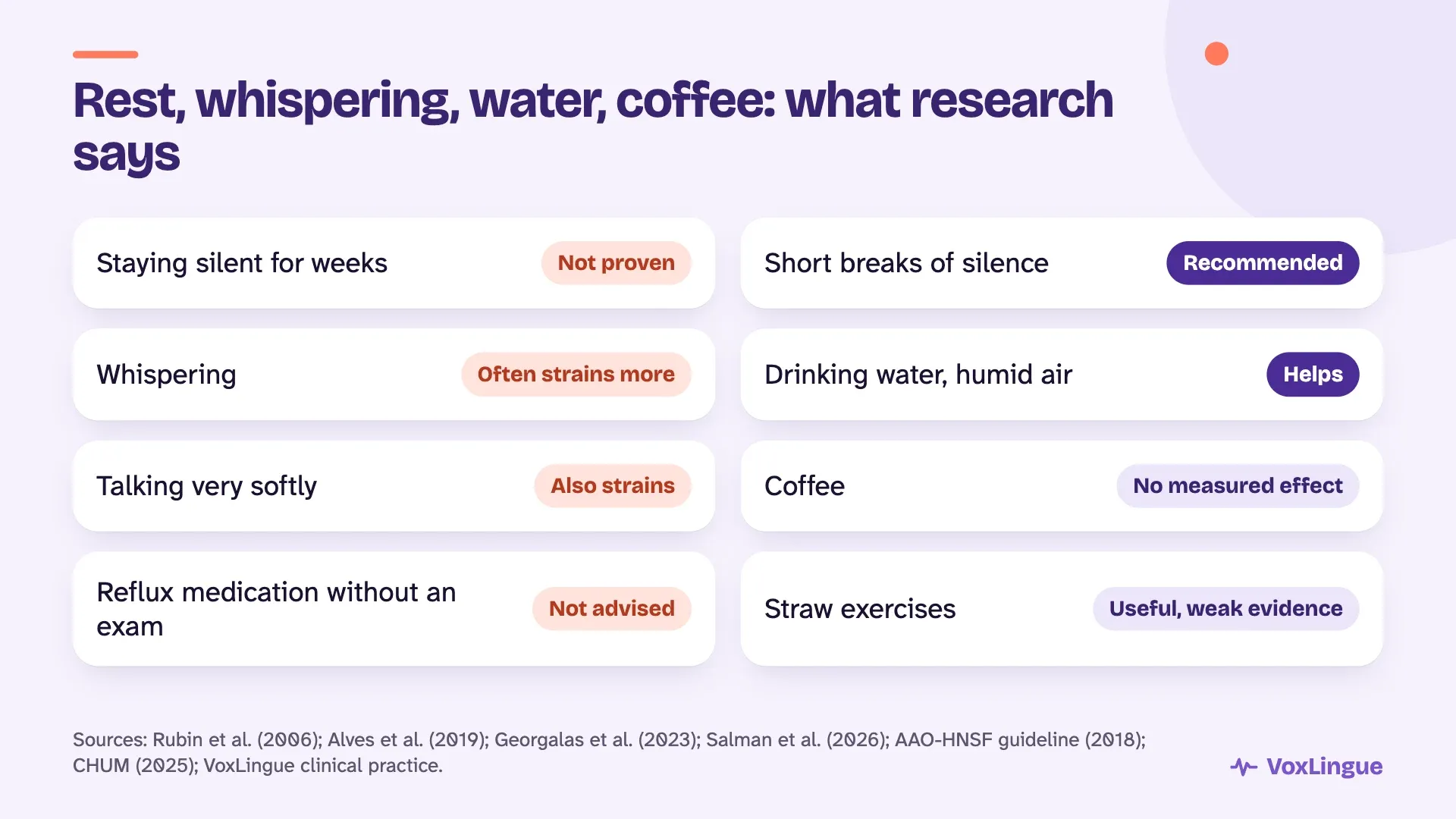
Straw exercises, widely used in voice therapy, are safe and often enjoyable, but the studies testing them are still low quality. We use them as one tool among others, not as a miracle fix. Finally, reflux shouldn’t be treated “just in case”: the clinical practice guideline advises against taking reflux medication for a hoarse voice without an exam of the larynx.
One last honest point: prevention programs have barely been studied. A Cochrane review found only two small studies in teachers, with no significant effect. The advice that follows rests mostly on clinical experience and on how the voice works, which doesn’t make it any less useful.
How to protect your voice every day
To protect your voice, lower the load: less volume, less distance, less noise. Add recovery with short periods of silence, keep your vocal folds hydrated, and get help early when your voice changes. The same principles apply to a child, a teacher and a singer.
Breathe while you talk
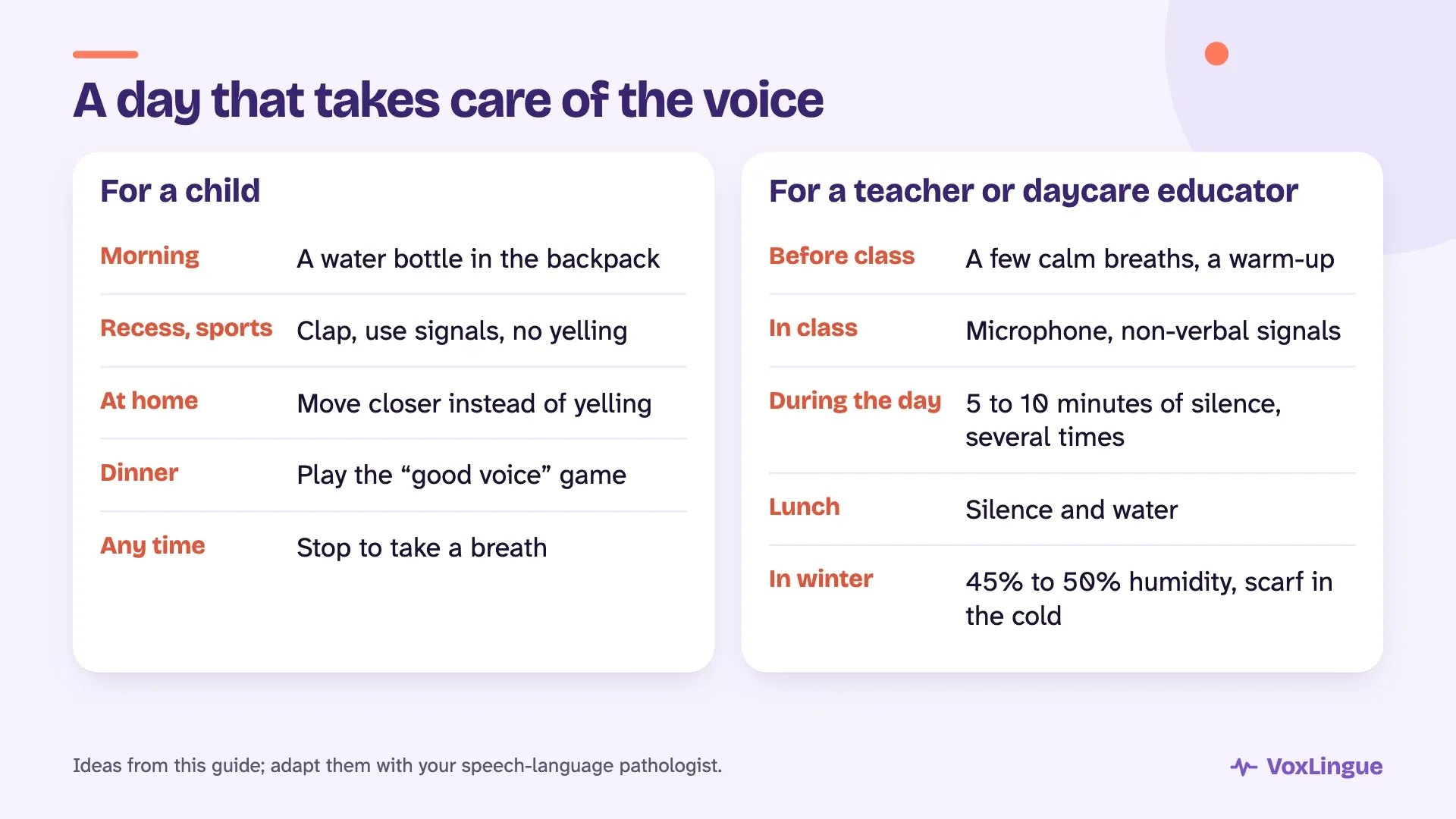
The tip that helps everyone is also the simplest: stop to breathe. Pause at the end of an idea or at a comma, take in air, then continue, instead of finishing the sentence out of breath. In front of a group, shorter sentences help. Before a class, a meeting or a game, a few calm breaths get the voice ready.
At home and at sports with a child
At home, the golden rule is to move closer rather than yell from one room to another. Go to your child, and ask them to do the same. Agree on signals to get attention without using your voice: a raised hand, two claps, a small bell for meals. With siblings, a “one at a time” rule protects everyone’s voice.
Turn the “good voice” into a game. With a 5- to 10-year-old, compare three voices: the shouting voice, the whispering voice and the good voice, the one that carries without strain. Ask them to say “Hi, my name is Leo” with each one, then keep the third one through dinner. Go easy on the big monster voices.
At sports, parents and kids can cheer without yelling: clapping, noisemakers or cowbells in the stands. Arenas and gyms echo and push everyone to shout louder.
If your child plays hockey or soccer, one sentence to the coach often does it: “She’s working on her voice with a speech-language pathologist. Could you encourage her to use a signal instead of yelling on the ice?”
Watch for mouth breathing too, day and night: it dries the throat. Our article on childhood oral habits and mouth breathing explains when to bring it up.
In the classroom and at daycare
For teachers, amplification has the strongest research support. In two US trials, a portable microphone and speaker reduced teachers’ voice handicap more than vocal hygiene advice alone (Roy et al., 2002 and 2003). If your voice tires, ask your school for an amplifier.
Noise is the main enemy. According to the Québec teachers’ union, noise in daycare averages 56 to 71 decibels, with peaks of 80 to 95, and classrooms peak at 97 decibels. A study by Québec’s occupational health research institute (IRSST) in daycare centres found that acoustic panels and ceilings cut noise by 6 to 7 dBA on average, and people spoke more softly.
Non-verbal signals make a big difference: a bell, a tidy-up song, an agreed gesture for quiet, switching the lights off. Transition routines mean you don’t have to repeat instructions at the top of your voice. Move close to the children rather than talking across the room, and keep a water bottle within reach.
If your voice disorder is work-related, you can file a claim with Québec’s workplace health and safety board (CNESST). It requires a written certificate from your treating physician, and you have to show the link with your work, because voice disorders aren’t presumed to be work-related. The Québec teachers’ union guide explains the steps in detail.
Singers, coaches and other voice professionals
The same principles apply, with a few additions. Warm up your voice before singing, teaching or presenting, and take breaks between sessions. Use a microphone whenever the group or the room is large. Coaches do well with a whistle and hand signals. Avoid singing or forcing your voice when you’re sick or very hoarse.
For singers, therapy is done in coordination with the singing teacher or vocal coach. The goal isn’t to change your style, but to give you a healthy, efficient voice to perform it.
Working all day in two languages
In Montréal, many people work all day in two languages or more. They switch between French, English and sometimes a third language, on the phone or at the counter. No study shows that being bilingual harms the voice in itself. What matters is the total load: hours of talking, calls, and speaking louder or faster to be understood. The same breaks and breathing apply.
Québec winters
Winter puts the voice to the test. Heating dries out the air at home, in classrooms and at the rink. Aim for 45% to 50% humidity at home and at work, as the CHUM recommends. In extreme cold and during winter sports, cover your nose and mouth with a scarf. Keep water within reach, even when you’re not thirsty.
Frequently asked questions
Are vocal nodules cancerous?
No. Vocal nodules are benign lesions caused by repeated, forceful voice use, and they don’t turn into cancer. A hoarse voice that lasts should still be examined by an ENT, precisely to confirm that it’s nodules and not another lesion, especially in someone who smokes.
Do vocal nodules go away on their own?
Sometimes. In many boys, they shrink or disappear at puberty, but far less often in girls. In adults, they usually persist if voice habits stay the same. Voice therapy helps the voice improve whether or not the nodule disappears completely.
How long do vocal nodules take to heal?
Voice therapy trials in children usually last 8 to 12 weeks. The voice often improves before the nodule shrinks, and the nodule gets smaller gradually, sometimes over several months. The pace depends on the size of the nodules, practice at home and daily vocal load.
Can you sing with vocal nodules?
Often, yes, with an adapted plan. Forced singing, or singing while sick, makes nodules worse, but well-supported singing without tension can be part of therapy. The ENT and speech-language pathologist help you decide what to sing, for how long, and when to return fully.
Can vocal nodules come back after surgery?
Yes, if the way the voice is used doesn’t change, because surgery doesn’t fix the cause. Studies show that voice therapy after surgery clearly lowers the risk of recurrence. That’s why starting with voice therapy is almost always recommended.
Can reflux cause vocal nodules?
Reflux can irritate the larynx and make hoarseness worse, but it doesn’t explain nodules on its own. The clinical practice guideline advises against taking reflux medication for a hoarse voice without an exam of the larynx. If reflux is diagnosed, treating it becomes part of the plan.
Is coffee bad for your voice?
The available studies found no measurable effect of caffeine on the voice. There are few of them, but nothing justifies giving up your morning coffee. What matters more is drinking enough water through the day and keeping the air humid, especially in winter.
Do I need a referral to see a speech-language pathologist?
Not in private practice in Québec: you can see a speech-language pathologist directly, without a medical diagnosis. Hospital voice clinics require a medical referral. For nodules, your speech-language pathologist will also recommend an ENT exam, which your family doctor needs to request.
Should I see an ENT or a speech-language pathologist first?
Both, in parallel. See your doctor to get the ENT consultation, which confirms the diagnosis. Because the wait can be long, a speech-language pathologist can start right away on vocal hygiene, habits and breathing, then adjust treatment based on the exam results.
Can a voice disorder be recognized by the CNESST?
Yes, a work-related voice disorder can be recognized as an occupational disease. You need a written certificate from your treating physician, and you must show the link with your work, because it isn’t presumed. The Québec teachers’ union guide on voice disorders explains the steps and your rights.
Does online voice therapy work?
Yes, for many people. A recent Boston Children’s Hospital study saw clear voice improvement in children with nodules treated online, in a group of only 23 children. Voice and breathing exercises work well through telepractice, anywhere in Québec and Ontario.
Does working or growing up in two languages raise the risk?
No data show that being bilingual in itself raises the risk of nodules. What matters is the total vocal load: hours of talking, noise, calls, and the tendency to speak louder to be understood. The same breathing and break strategies apply in every language.
Printable guide: protect your voice
To keep these tips handy, print our two-page guide. The first page is for families: the signs, the good voice, breathing, and ideas for home and sports. The second is for school and daycare staff: signals, breaks, noise and amplification.
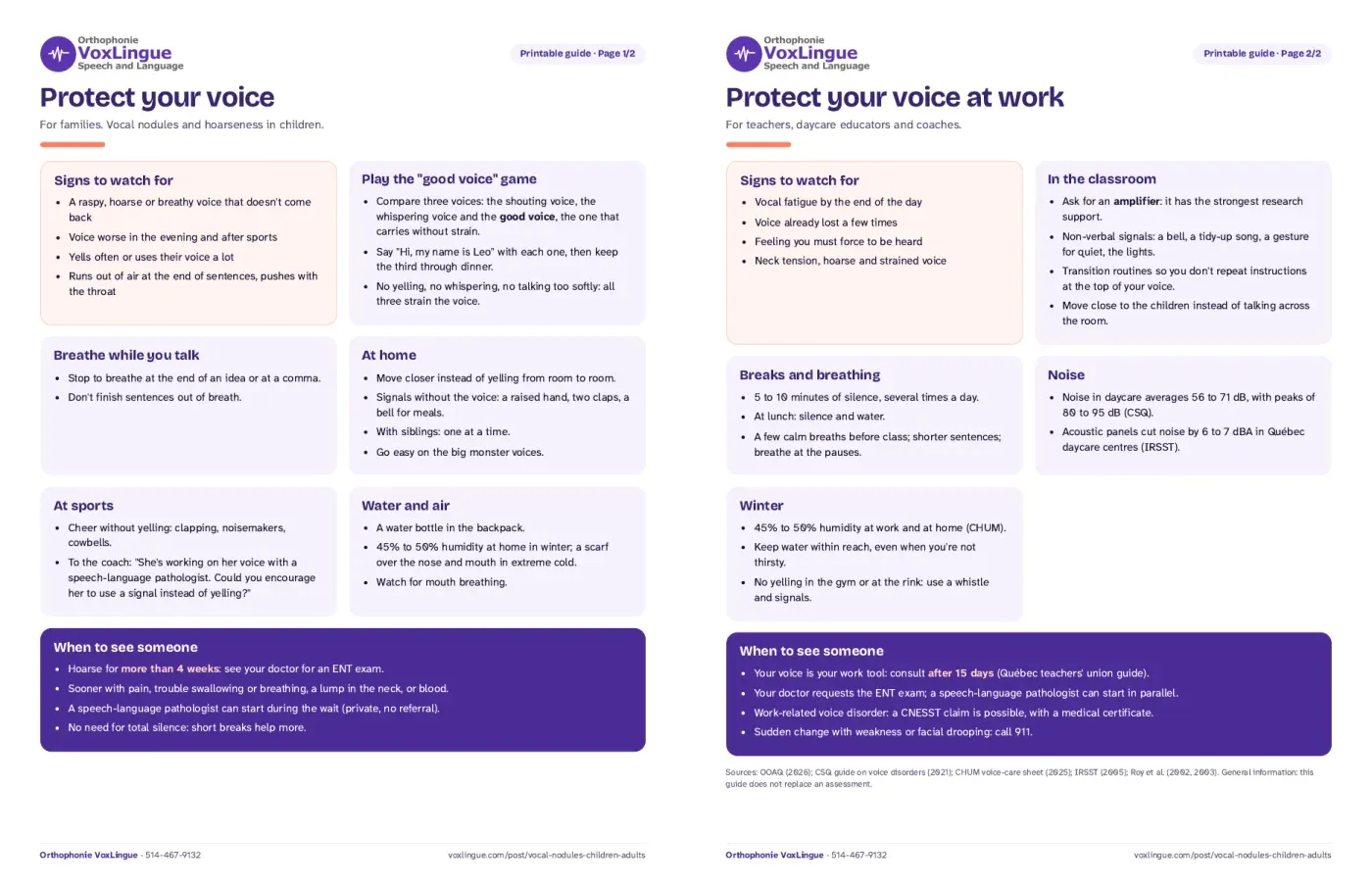
Printable guide: Protect your voice, for families and schools (PDF, 2 pages). Put it on the fridge, in the classroom or in the staff room.
Taking care of your voice, starting now
A hoarse voice that lingers isn’t something you just have to live with, for a child or an adult. In most cases, vocal nodules respond well once you understand what tires the voice, learn to breathe better and change a few habits, with the right help at the right time.
If your child’s voice, or your own, has been hoarse for more than four weeks, start with your family doctor to get an ENT exam. Our speech-language pathologists can work with you during the wait, at our Montréal clinic or online, then coordinate with the ENT. To learn more, see our page on voice therapy, our speech therapy services for adults and children, or our other articles for adults.